A twelve-step process for turning a script into a living, breathing person — in the same order, every time. Ivana Chubbuck built it over forty years in Los Angeles. This page explains what the steps are and why the order is the whole point.
Most training teaches you to recognise good acting. You learn to feel when a scene is alive and when it's dead. What it rarely gives you is a way to get from one to the other on purpose.
So you read the sides, you get an idea, and then you circle it for three days hoping it lands. Some days it does. On those days you can't explain why, which means you can't do it again on Thursday when the tape is due.
The Chubbuck Technique is a sequence of decisions you make before you speak. Twelve of them, in order. Once they're made, you stop thinking and start playing — because the thinking already happened.
This is the part that gets left out when people describe it, and it's the reason it works.
The steps aren't twelve topics you could take in any sequence, like modules on a course. Each one depends on the answer to the one before it.
You can't decide what your character wants in a scene until you know what they want from their life. You can't find the obstacles until you know what they're obstructing. You can't choose a substitution — a real person from your own life to put opposite you — until you know what you need from them and why you can't get it. You can't personalise a single line until you know who you're really talking to.
Try to do step four first and you get a choice that feels good and goes nowhere. Do them in order and each one narrows the next, until by step twelve there's only one honest way to play the scene and you can stop managing it.
That's the difference between a technique and a collection of exercises.
Here's the whole sequence. In class you learn to run it yourself, on any script.
Steps one to five are the foundation, and they're what you learn in the two-afternoon Intro. The rest is built on top of them in the monthly class.
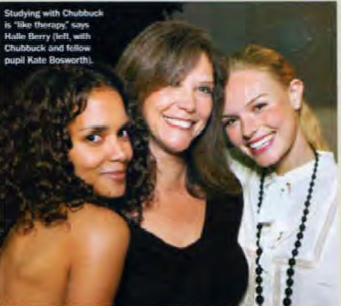
Brad Pitt. Charlize Theron. Halle Berry. Jake Gyllenhaal. Sylvester Stallone. Jared Leto. Eva Mendes. Jim Carrey. Aubrey Plaza. Travis Fimmel.
Different agents, different studios, different careers — one technique. Halle Berry thanked Ivana from the Oscar stage.
It isn't about feeling more. It's about using what you feel to go after what your character wants.
Ivana Chubbuck — on Brad Pitt's early work ethic, and why Sylvester Stallone came back to study.
Ivana Chubbuck — how Eva Mendes used Overall Objective in Training Day.
No. Method acting asks you to become the character and stay there. This asks you to use your own life as fuel for what the character is going after, and then put it down at the end of the session.
You go home as yourself. That's a design feature, not an accident.
No, and I'd steer you away from it. We work with unresolved issues, not trauma — a frustration, a heartbreak, an apology you never got. Something with a live charge that hasn't been settled.
This isn't therapy and it isn't a substitute for it. If you're currently receiving treatment or support for your mental health, have a word with your practitioner before you book, and tell me on the welcome call so I can work with it.
Most training is built around exploration — you try things, a tutor responds, and over three years you develop taste. That's valuable and I'm not knocking it.
What it often doesn't leave you with is a repeatable order of operations for a script you've never seen, with a deadline. That's the specific gap this fills. Plenty of people here are drama school trained.
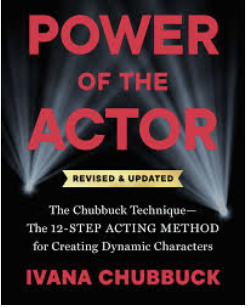
Yes — The Power of the Actor by Ivana Chubbuck. Before your first class you need the first four chapters, which is a couple of evenings. The work in the room assumes it.
You don't need to have finished it or understood all of it. That's what the class is for.
I do. I trained under Ivana from 2016 and in 2021 she invited me to teach her technique here. I'm still a full-time member of her masterclass, which means the material is current rather than remembered.
There are a small number of accredited teachers worldwide, listed on her own studio's site.
You don't need to be good yet. You need to be willing to work and to be seen doing it badly for a bit.
The room will usually have someone further along than you in it. Five years of teaching has shown me that speeds people up rather than embarrassing them — you learn a lot watching someone solve a problem you're about to have.
If you're genuinely not sure, email me and we'll work it out together. I'd rather tell you it isn't the right moment than take your money.
If none of this was familiar an hour ago, the Intro is the sensible first move — two afternoons on the first five steps, in a room of six, for £97.50. Finish it and your first monthly block is £175 instead of £195.
Registration opens on the 1st of every month for the following month. The mailing list hears first.